Showing posts with label creation. Show all posts

Monday, August 25, 2008

Thoughts on "Co-creation"

From an early age, my sisters and I were creative; I thought up my first song on the occasion of my sister Valerie's birth, when I was five. I could still sing it for you, but it is no Mozartian production, so I won't. In any case, without thinking much of it, in my family, we made up songs, games, wrote short stories and such throughout childhood. We would not necessarily have appeared to be artsy family or an American Von Trappe imitation. It has been something of a surprise, as I've aged, to discover that few children have this type of experience. We rarely watched television. At Grandma's house, entertainment seemed to spontaneously erupt after a few post-dinner Manhattans: the accordion, clarinet, and trumpet would appear from nowhere, someone would sit at the piano, and everyone who could would perform German polkas and waltzes. I participated in these 'jam sessions' several times, even though no one ever taught me any of the songs; you just listened hard and figured out what to play as you went along. I fear that I may be the only cousin of my generation to have learned any of these pieces, and here I am in a monastery.

I continued to write music, eventually making a profession of it briefly before my entrance into monastic life. In college, I came under the spell of the Second Viennese School. I can't say exactly what drew me to it, except that the music of Schoenberg, and especially Webern, struck me as something totally new, whereas I had adopted what I now believe to be a naive stance vis a vis 'classical' music, that it doesn't have much variety, and (importantly) that this apparent quality is a bad thing. (My later study of late Beethoven and the Renaissance music of Josquin changed my mind on this point)

I began composing music 'that had never been heard before'. In fact, much of the music I produced at the time (I was about 21-22) is music that I am quite proud of in a good way. Some of it became simply unplayable. Little of it was ever performed, since performance requires other persons to learn the music and an audience willing to listen. This alignment was rare enough that what came of this period of creativity is limited to a few recordings, mostly 'scratch' recordings, meant to be works in progress.

Later, I encountered many others who wished to create music that 'had never been heard before'. I came to recognize this as a kind of temptation. Often times, we can imagine sounds in our heads that in fact correspond to nothing concrete in the world, and therefore this music cannot be heard literally. Often what is meant is that a person has a feeling that he or she wants to evoke with music, but does not know how to do it, and imagines that no music has ever been written to evoke this feeling. This corresponds to the serious difficulty in modern community life of individuals imagining themselves with totally unique feelings and experiences, assuming that others cannot understand them and therefore completely at sea when it comes to making decisions.

As I suggested above, these, I have come to believe, are temptations of the Deceiver, who wishes to divide person from person. This is not to say that musicians should not try to be original. In my better moments as a composer, I recognized that I could not really help but be original; we really are unique persons. But if I wished to communicate with others, I had to use reference points that others could understand. The idea then is to take the materials already provided and arrange them in a new way. The effect might not be totally new, but why shouldn't that be alright?

Creativity in the human person is fascinating to me. Of course, our creativity is always limited by the Creator, Who set the parameters for making new artifacts with created things. The longing to make something 'that no one has ever heard' can be interpreted as a longing to usurp the Creator's rightful place, rather than at least working with Him.

These are preliminary thoughts on a topic that is not yet well formed in my understanding. I hope that it is interesting for anyone reading!

Monday, August 06, 2007

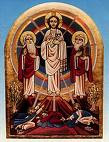
Transfiguration

This Feast day happens to be the day upon which, in 1945, the United States military decided to initiate nuclear war. I recommend this piece for any thoughtful Christian about the difficulties (impossibility?) of reconciling modern warfare with the Gospel. (I distinguiah modern warfare from the highly stylized and professionalized warfare practiced by Christian states from medieval times until either the American Civil War or the Great War.)

What the Apostles witnessed on Mount Tabor is a reality infinitely beyond and superior to earthly realities. This in no way denigrates these earthly realities: Jesus remains recognizable as a human being, as do Moses and Elijah. The brightness of the Transfiguration is compared by the evangelists to earthly realities: the sun, snow, bleach. When we receive baptism and become united to the life and Love of the Holy Trinity, earthly realities become infused with their true meaning, to lead us to blissful union with God and with His creation.

By contrast, the Devil is a Murderer from the beginning and the Father of Lies. Violence and falsehood are his tools against the goodness of Truth and reality. We human beings should be extremely cautious about the legitimate use of force and the prudential withholding of truth in our political lives, lest they imperceptibly bleed over into outright violence and lies. Without pointing fingers at those involved, I believe that Christians should be forthright in condemning the bombings of Hiroshima and Nagasaki as totally immoral. This is rarely done because prudential justifications of these actions have taken the place of the 'searching and fearless moral inventory' all Christians ought to make. This rationalizing is especially unnerving at a time when so many on the Christian right (disclosure--this is where most people would put me) seem to think that strength of character is demonstrated by a willingness to threaten violence--aka bombing Mecca and Medinah--rather than suffering for the sake of Truth.

In the preface of today's Divine Liturgy, we are instructed by the Church to pray, "He revealed his glory to his disciples to strengthen them for the scandal of the cross." In his Apostolic exhortation Vita Consecrata, Pope John Paul II similarly taught that the Transfiguration is an event meant to strengthen us against falling away in the face of threatened violence against ourselves. The destruction of human life is contrary to the message of the glorified human body of Jesus Christ. Do we lack faith in God's power when faced with threats to our way of life? Is saber-rattling really the best way to make the world safe for democracy?

Wednesday, January 17, 2007

"He is the image of the invisible God, the first-born of all creation; for in him all things were created."
Col 1: 15-16a

Two observations:
1) This is a passage that Arius made use of to claim that the Son was a created being, that is, that the Son is not the eternal God. The difficulty revolves around the term 'born' (here tokos). My contention here, as I have suggested in other passages involving birth, is that the biblical idea of birth is different than ours. We see birth as the beginning of something that didn't exist before. Biblical passages regarding birth see it more as a change of status, a separation that is a beginning, not of a new ontological item, but of a new stage. The eternal begetting of the Son is His eternal differentiation from the Father, as it were. Jesus' birth as a man similarly does not mark the beginning of the idea of God becoming man, which seems rather to have been part of the willing of creation from all eternity. The Son of God is born as God, now not only as the Son of God, but as a man as well.

2) The refrain throughout this hymn in Colossians "all things" (seven times in vv. 15-20, according to the Greek) surely emphasizes that the Son is not a 'thing', is not part of the panta, all the 'things' created through Him. Surely, as we profess each Sunday, He is 'begotten, not made'.

P.S. I hadn't been blogging so much this past week because I have been at work adding new bits to our website. I encourage you to visit and check out our new chant and new table reading selections, as well as the very neat podcasts of the monks' homilies.

Imprimatur

This blog is published with ecclesiastical approval.


If I, who seem to be your right hand and am called Presbyter and seem to
preach the Word of God, If I do something against the discipline of the Church
and the Rule of the Gospel so that I become a scandal to you, The Church, then
may the whole Church, in unanimous resolve, cut me, its right hand, off, and
throw me away.


Origen of Alexandria
Locations of visitors to this page