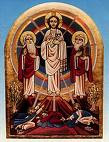
Holy Saturday and the Mother of God
Holy Week forms the background of each week of the Church's liturgical calendar. For this reason, throughout the year Sunday is 'The Lord's Day', the solemn commemoration and celebration of the resurrection of Jesus Christ. Even in Lent, we do not fast on Sundays.
Similarly, on Friday, we have the custom of fasting and abstinence, even outside of Lent. This practice has been somewhat mitigated in recent decades, and I think that there is a real loss in this, even if there had been problems with scruples and abuses surrounding the 'no meat on Friday' rule that held for Catholic for many centuries.
Thursday, while the association is rather muted, pops up as a day to remember the Last Supper and with it, the institution of the Eucharistic sacrifice and the ordained priesthood. Pope John Paul II, when suggesting the new 'Mysteries of Light' for meditation during the rosary, also suggested that they be used on Thursday, and included in them the institution of the Holy Eucharist.
We might expect that Saturday would be an extension of the mourning begun on Friday. Instead, we find a very long tradition of dedicating Saturday to the Blessed Virgin Mary. Is this a mistake? A blip caused by overzealous churchmen and pious laity in their devotion to our Lord's mother?
In fact, the devotion to Mary on Saturday is indeed connected to Holy Saturday, though it requires the eyes of faith to read this association. As she so often does, Mary stands as a prototype for the Church. The Church was given birth on Good Friday from the side of our dying Savior, as Mary stood beneath him (her 'Head') with the Apostle John. Mary, as the first believer, the first to be redeemed as the Theotokos, the God-bearer, is the model of the Church that does not lose faith, even through persecution, even through death. Jesus' death is a cause for mourning, yes; but through the eyes of faith, it is a cause of wonder and, if we may say so soberly, joy. For in the eyes of faith, this death has won our salvation, has forgiven our sins, has restored us to life and communion with the God Who Is Love, has trampled down death forever and unleashed the power of the Holy Spirit for the recreation of the cosmos. The Catholic Church bears witness to this today: our Lord's body lies dead in the tomb, but we believe that He will rise, and that we have no more need to fear. All we need do is believe and wait. What can mortals do to me? Indeed, what can Satan himself do to me, with the knowledge I have that he has been defeated?
There are fleeting references to Mary's unshaken faith on Holy Saturday scattered in patristic meditations on the theme. The sense of Saturday as the day of Our Lady who did not waver and 'was not scandalized on account' of her Son's death, began to coalesce in the Benedictine centuries of the Middle Ages. It is a helpful thing to meditate on the demeanor, the prayer of Mary on this day, the day on which the disciples' faith was weighed in the scales, and most of them were found wanting. Indeed, even after the resurrection, we find them hiding away, until their baptism by the Holy Spirit on Pentecost. The exception is Mary, whose baptism took place in the 'overshadowing' of the Holy Spirit at the Annunciation. We who have received the gift of the Holy Spirit in baptism do well to reflect on the Mother of God as our model of discipleship, even if the unregenerated parts of us take their cue more often from those who ran away, hid and generally despaired. While we can take our comfort and strength from our incorporation into Christ's Body and bride 'without stain or wrinkle', as individual believers, it is helpful for us to gaze upon the disciple who offers the pattern of following Jesus with total faith, hope and love.
Sr. Genevieve Glen, OSB, recently gave an exellent reflection on Judas as a mirror of our own infidelity, precisely because so little is said about his motives in the gospel. In a similar manner, Mary can be our mirror of faith, precisely because so little is said, simply the fact that she did not leave her Lord at His passion.
Pray for us, O Virgin Mother of God, that we may be made worthy of the promises of Christ!
P.S. Happy Easter, Michael! You are welcome to post whatever comments and observations you have. Hope to see the whole family sometime at Easter!